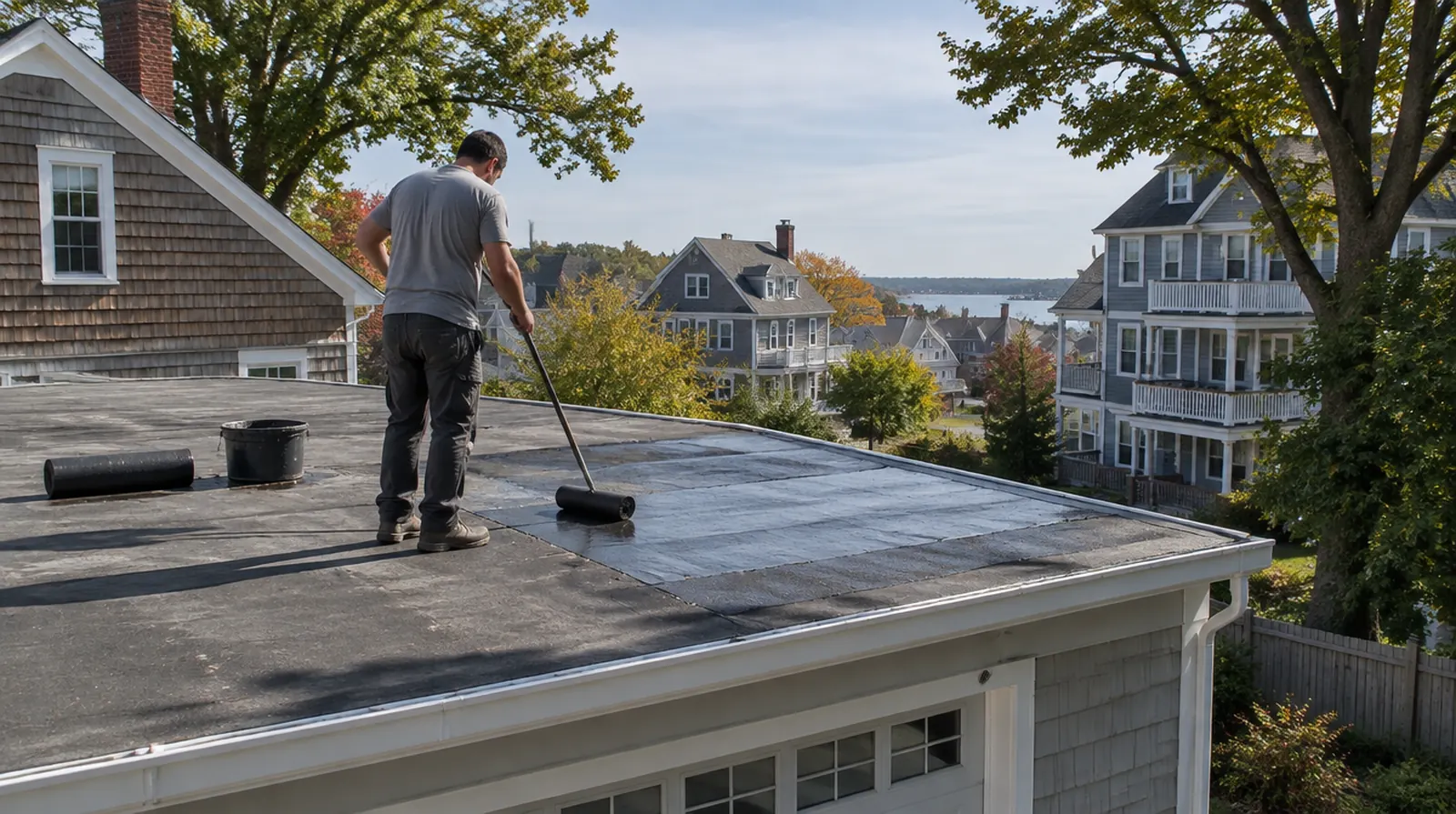
Flat roof repair issues in Quincy buildings
Snow sits on low-slope roofs for days and melts slowly. When drains or scuppers are clogged, meltwater ponds and refreezes, opening seams and stressing the membrane. Older built-up and roll roofs crack with age, and blisters form where moisture is trapped. Parapet walls on triple-deckers have flashing and coping that fail over time, letting water into the wall cavity.
Porch and bay roofs have their own problems. They are small and low, catch snow sliding off the walls above and often have improvised flashing where they meet the building.
How we repair low-slope roofs

We inspect the whole roof, checking seams, edges, parapets, drains, scuppers, hatches and penetrations, and probe for soft spots that point to wet insulation or decking. Then we explain what we found.
Repairs use materials compatible with what is there: modified bitumen, EPDM, TPO or roll roofing. Seams are cleaned and resealed or rewelded. Parapet flashing is rebuilt and coping resealed. Drains are cleared and their flashing renewed. When ponding is the root problem, we can add tapered insulation or an additional drain or scupper.
Flat roof repair on triple-deckers
On a triple-decker, a leak in the main roof usually shows up in the top-floor unit first. Common sources are the drain flashing, the parapet base flashing, the roof hatch and the chimney. We check each one, and we look at how water moves across the roof to the drain, since even a slight sag can create a pond that slowly works into a seam.
Repair or replace?
A flexible membrane with isolated damage is worth repairing. A brittle, heavily patched roof, or one with soaked insulation, is usually better replaced. We show you photos and lay out both options.
Snow, ice and drainage
Clear drains are the single most important part of flat roof care in Quincy. We clean and test drains during every repair and recommend strainers to keep leaves and debris out. On problem drains, we can discuss heat cable or other options for winter.
Rooftop equipment and foot traffic
AC units, vent stacks and satellite dishes on a flat roof create penetrations and attract foot traffic. We seal around them and can add walkway pads.
Roof hatches and skylights
Many triple-deckers have a roof hatch reached from a top-floor closet or stairway, and some have old skylights. Hatch curbs and skylight frames are common leak points because their flashing is often decades old and their seals have hardened. We reflash curbs, replace worn gaskets and, where an old skylight cannot be saved, discuss a replacement unit or framing it in.
Porch roof rebuilds
Front and rear porch roofs on Quincy's multi-families carry snow that slides off the walls above. When the edges rot or the membrane is cracked throughout, we rebuild the roof with new decking at the edges, a new membrane suited to the low pitch and proper flashing tied into the siding. Gutters or drip edges are added so water does not land on the stairs.
We finish each repair with a water test at the drains and photos for your records.
Coatings and maintenance
A reflective coating over a sound membrane can cut summer heat in top-floor units and add some life, but it will not save a roof that is already failing. We tell you honestly which applies. Twice-yearly drain cleaning and a quick look at seams and parapets after big storms keep a flat roof in good shape.
We also check where the flat roof meets any pitched section, since that transition carries a lot of water.
Flat roof repair FAQs
Do you repair porch roofs?
Yes, including where they meet the building.
Can you fix ponding?
Often, with tapered insulation or an added drain.
Can you repair in winter?
We can make temporary repairs on clear days and permanent ones when conditions allow.
How do I schedule?
Call (781) 773-2885.
Have a low-slope leak?
Call (781) 773-2885 for a free flat roof repair look.